


Clinsight for Patients
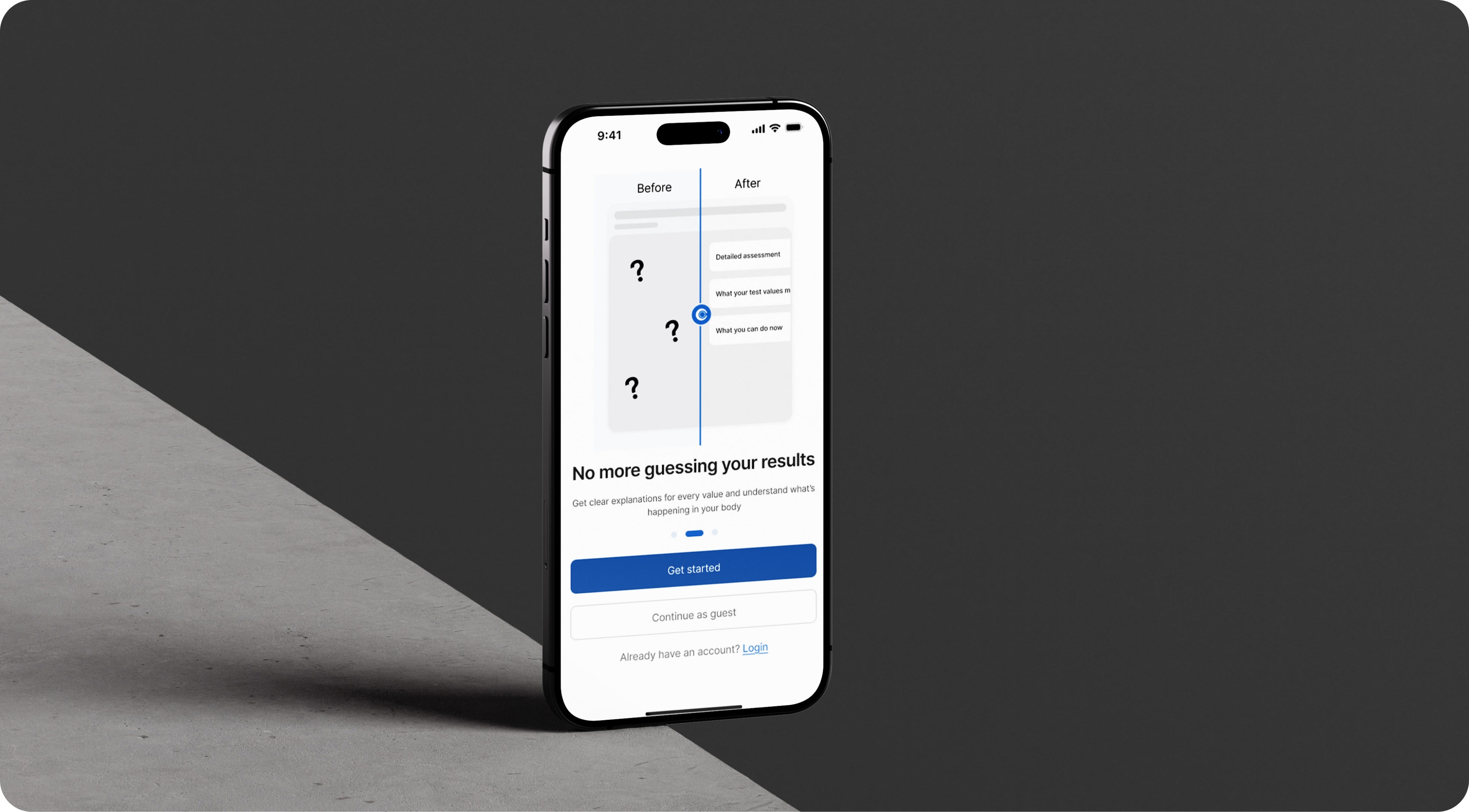
Product DesignAI-AssistedClinsight is an AI-powered healthcare platform designed to make laboratory results easier for patients to understand. Instead of leaving users to interpret complex medical terminology and numerical values on their own, Clinsight transforms lab reports into clear, plain-language explanations that are easy to follow.
- Role
Product Designer
- Team
- 4 Product Designers3 Software Engineers1 Product Manager1 AI Engineer
- Problem
Receiving laboratory results can be overwhelming for patients without a medical background. Our challenge was to design an experience that made health information easier to understand while promoting informed decision-making.
- Solution
Clinsight empowers patients to better understand their laboratory results by combining optical character recognition (OCR), AI-powered interpretation, conversational follow-up, and optional doctor reviews into a single experience.
Scope & Delivery
8
core patient flows owned end to end
6
reusable component groups established
I owned the core patient journey end to end, onboarding, authentication, lab report upload, OCR processing, AI interpretation, follow-up chat, doctor review requests, and interpretation history. Alongside the flows, I established reusable components and consistent patterns for inputs, buttons, cards, navigation, states and feedback, so the experience stays coherent as the product grows. Design decisions were shaped through team reviews, workflow analysis, and iteration focused on clarity and ease of use.
The Goal
From the outset, our team aimed to create a healthcare experience that made laboratory results easier for patients to understand, regardless of their medical knowledge.
We wanted AI to communicate complex health information in a way that felt clear, trustworthy, and easy to follow, helping users feel informed rather than overwhelmed. At the same time, it was important to recognize the limits of AI by encouraging patients to seek a professional medical opinion whenever additional reassurance was needed.

Understanding the User
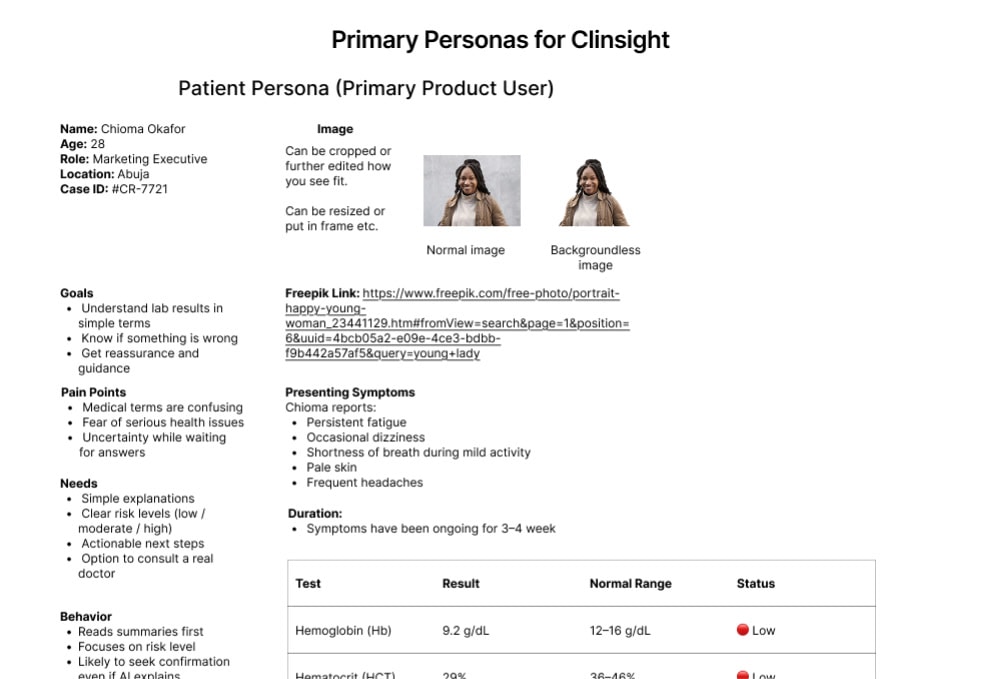
Our primary audience included busy professionals, underserved patients, and health-conscious individuals who regularly undergo laboratory testing but often lack immediate access to healthcare professionals.
Although their circumstances differed, they shared similar needs. They wanted quick, reliable explanations of their results, reassurance that the information could be trusted, and guidance on what to do next without feeling overwhelmed by medical terminology.
Addressing these became central to our design strategy.
Challenges
One of the most significant challenges was designing an experience that simplified medical information without oversimplifying it. Every screen had to strike a careful balance between clarity and clinical responsibility.
My Contributions
As a Product Designer, I collaborated closely with other designers, developers, product managers, and AI engineers throughout the project. My responsibilities included mapping user journeys and high-fidelity interfaces, building reusable components, creating interactive prototypes, and refining flows through team feedback and iterative design reviews.
Product User Flow
- 1
Onboarding
Introduces Clinsight and how AI-powered insights can simplify lab results.
- 2
Sign Up / Sign In
Secure account creation with access to previous reports and reviews.
- 3
Upload Lab Report
Patients upload their lab report as a PDF or image.
- 4
OCR Processing
Lab data is extracted and prepared for analysis.
- 5
AI Interpretation
Complex results are translated into clear, patient-friendly insights.
- 6
AI Follow-up Chat
Patients ask questions and explore their results further.
- 7
Doctor Review
Patients can request a verified doctor's second opinion when needed.
- 8
History
Reports, AI insights, conversations, and doctor reviews are saved for later.
Onboarding
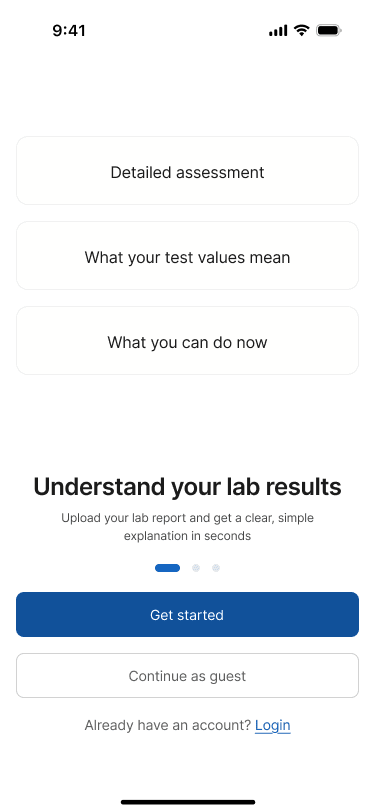
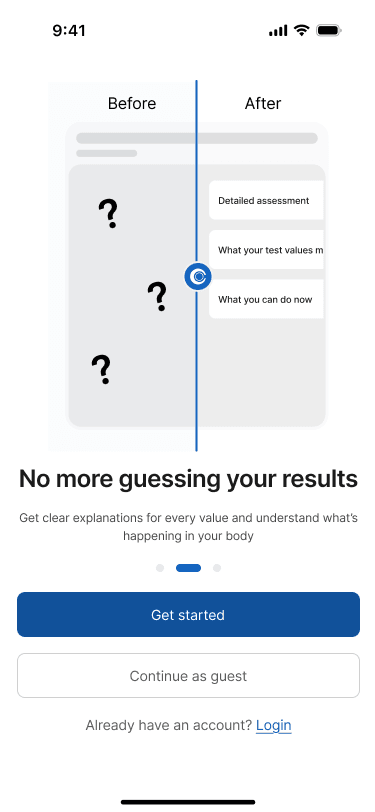
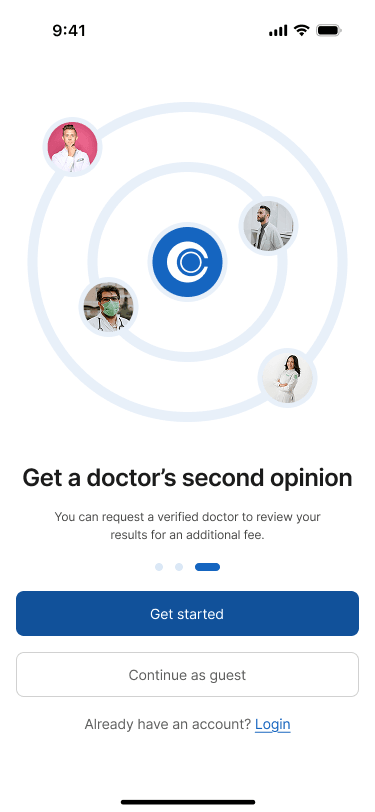
Onboarding had to introduce an unfamiliar idea before asking for anything in return. A short introductory sequence explains what Clinsight does with a lab report and what a patient gets back, so the first thing a new user meets is an explanation rather than a form.
The decision that shaped the rest of the flow was offering two ways in rather than one. Alongside the standard sign-up, the same screen offers a guest route. Rather than forcing registration upfront, users could immediately upload a lab report, receive an AI interpretation, and ask a limited number of follow-up questions before deciding whether to sign up, letting patients judge the platform on its own output instead of on a promise made before they had seen it.
An account is what the rest of the product depends on: saved reports, interpretation history and doctor reviews all need somewhere to return to. The guest route is bounded for that reason rather than built as a parallel version of the product. It exists to earn the account, not to replace it.
Uploading a Lab Report
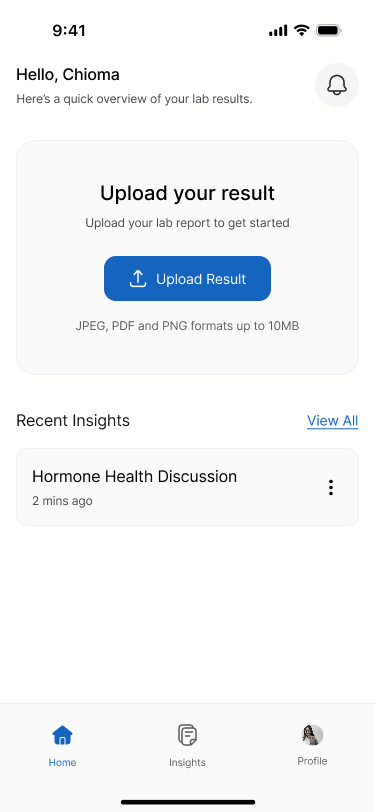
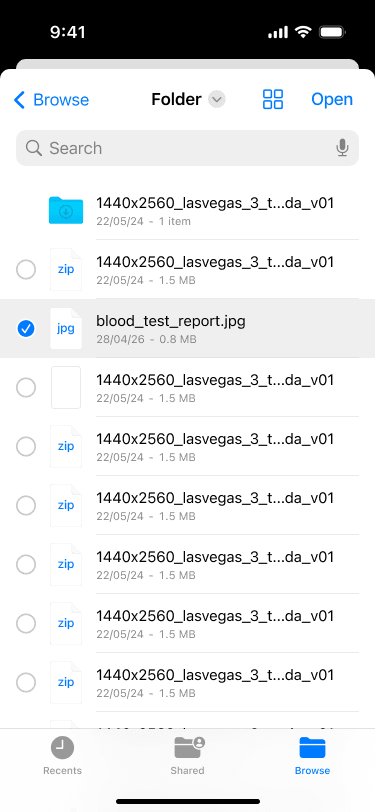
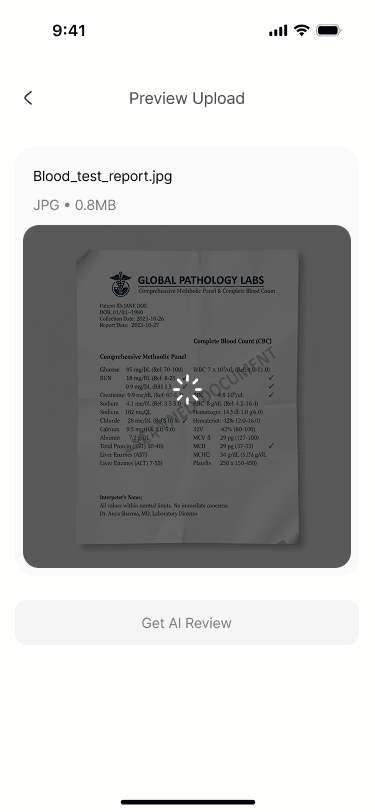
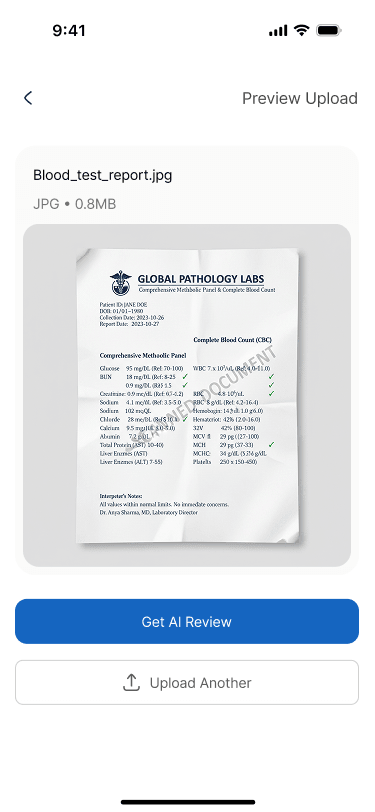
Uploading a report is the first meaningful interaction patients have with the platform, so simplicity was essential. Users can upload PDF or image files, after which OCR extracts test names, values, reference ranges, and units for AI analysis.
AI Interpretation
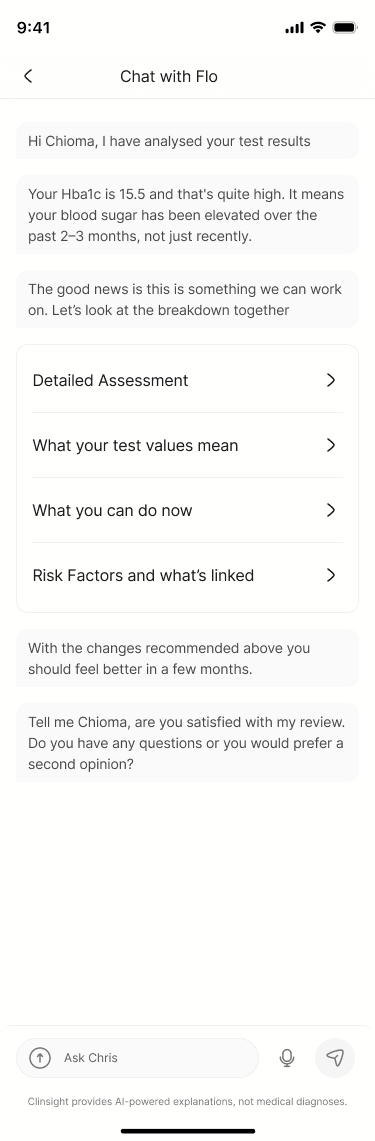
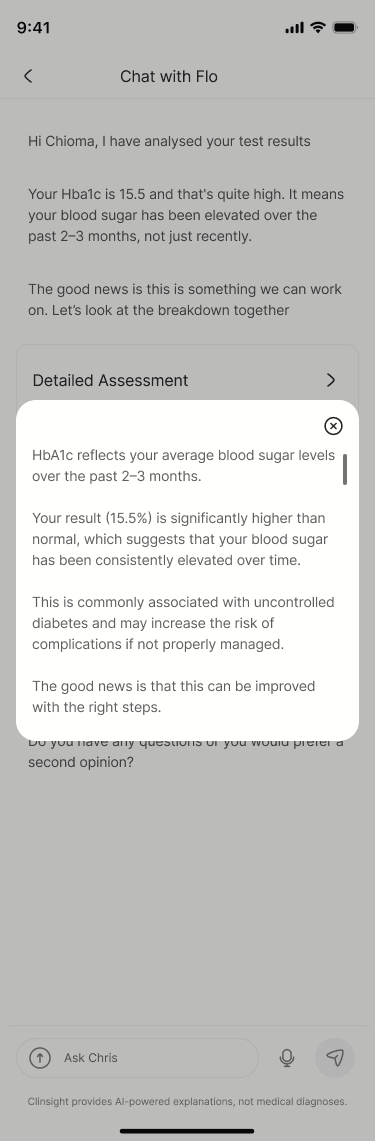
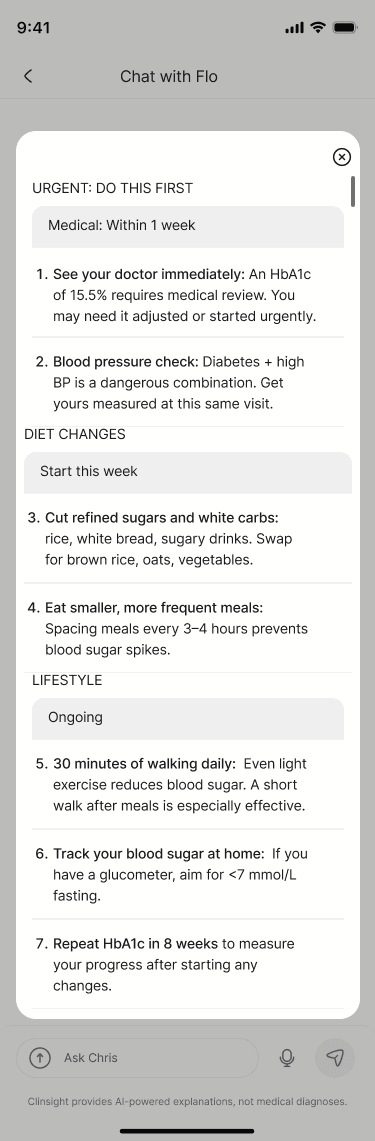
Instead of presenting patients with raw clinical values, Clinsight transforms their results into a structured explanation consisting of a plain-language summary, a breakdown of abnormal values, and suggested next steps.
We framed the output as an interpretation of laboratory results rather than a diagnosis. The language focuses on helping patients understand what their results could mean without making definitive medical claims, and the option to request a verified doctor's review stays visible throughout, reinforcing that the AI provides context rather than replacing professional medical judgment.
That boundary also decided what we chose not to show. We avoided severity scores, definitive diagnoses, and statements suggesting a patient had a specific condition, all of which would make the AI appear more medically authoritative than intended. Instead we focused on giving patients useful context while keeping a clear line between AI interpretation and professional clinical opinion.
Conversational AI
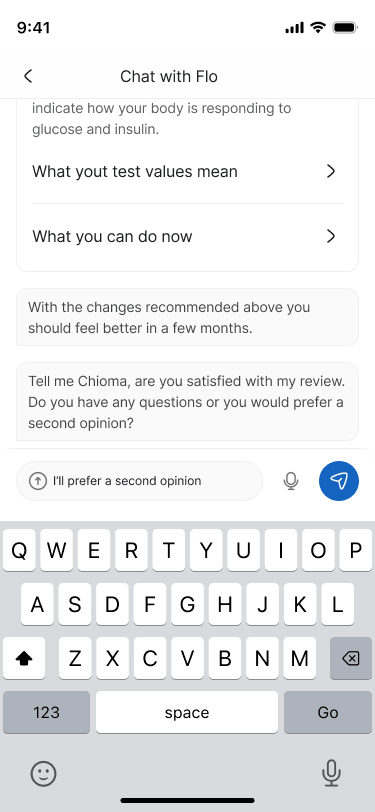
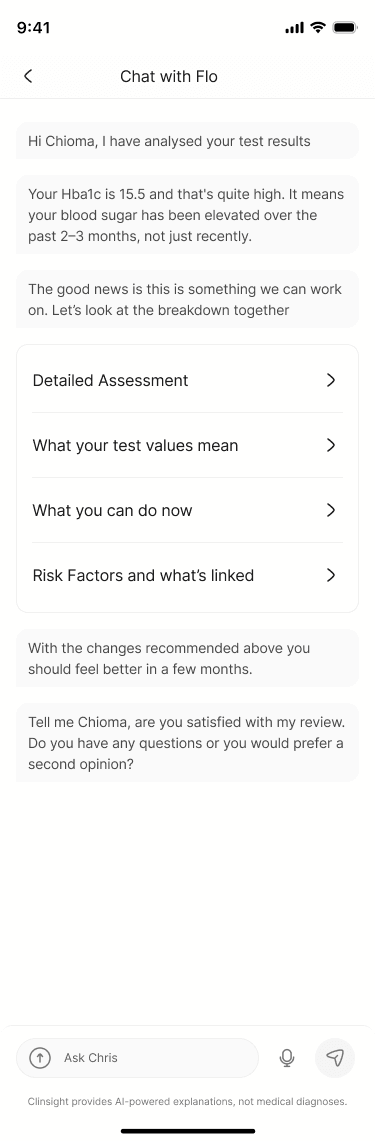
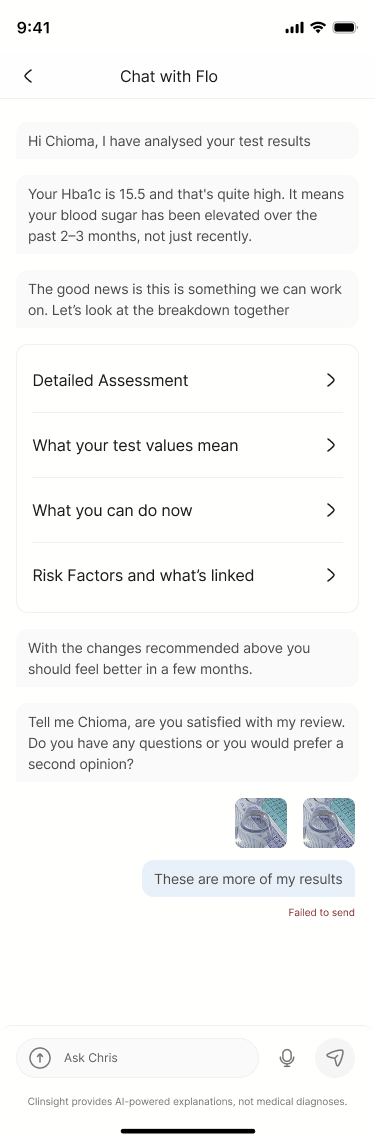
Understanding health information often raises additional questions, so we designed a contextual AI chat that allows patients to continue the conversation based on their uploaded report. By maintaining context throughout the interaction, users receive explanations tailored to their specific results rather than generic health information.
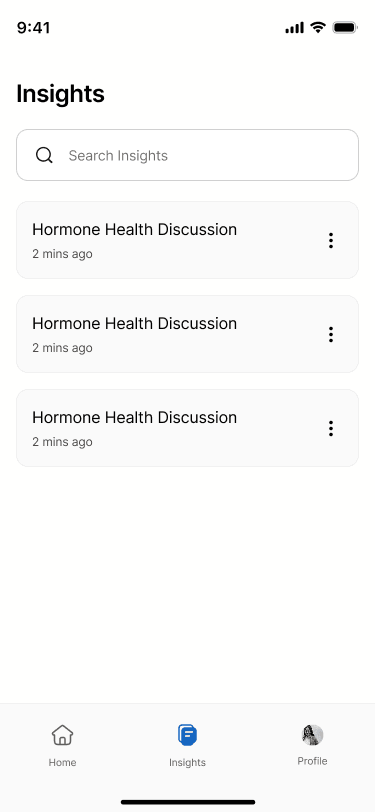
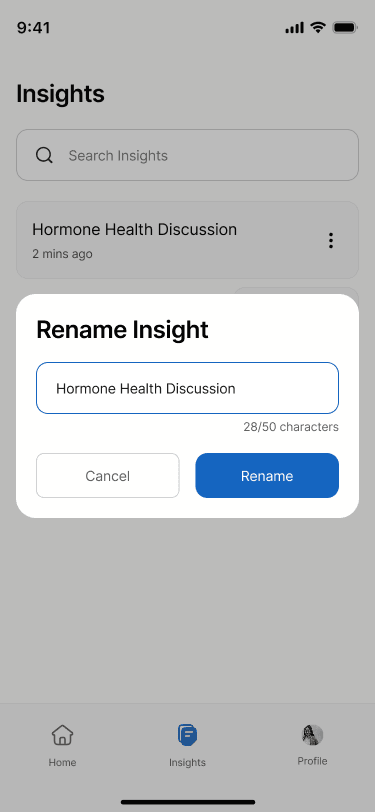
Insights Page
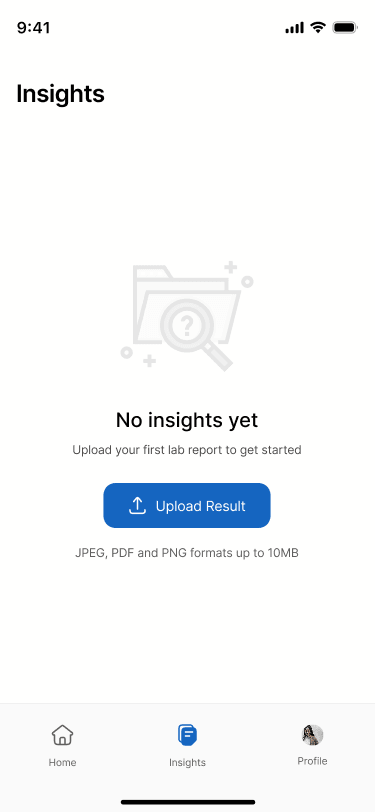
The Insights page gives patients a centralized view of AI-generated health insights based on their uploaded laboratory reports. Each insight presents a concise summary of key findings, making it easy for users to revisit important information without reopening individual reports.
Key Takeaways
Working on Clinsight reinforced the importance of designing for trust in healthcare. Unlike many consumer products, every interaction carried the potential to influence how someone understands their health. This required thoughtful collaboration across design, engineering, AI, product, and marketing to ensure the experience remained clear, responsible, and user-centered.
The project strengthened my ability to simplify complex information, design AI-assisted experiences responsibly, and collaborate within a cross-functional team to deliver solutions that balance user needs, business goals, and patient safety.